

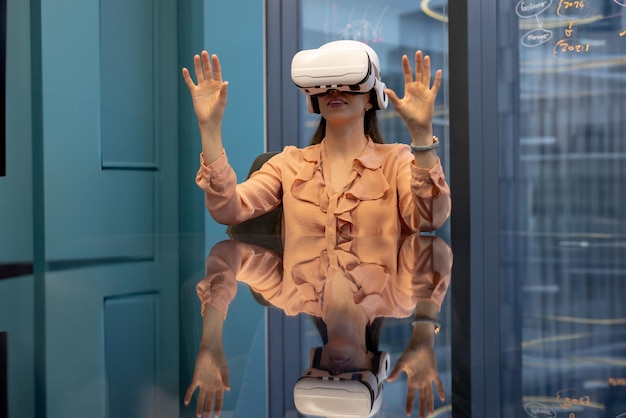
Imagine being able to immerse yourself in a world that perfectly matches your desires – all through just a few words or images. It sounds like magic, but it has actually become a reality, thanks to the impressive development of AI-generated 3D environments in VR. I must admit, when I first read that, I nearly fell off my chair. The potential of this technology is limitless and opens up entirely new dimensions for gaming, education and even work.
In this article, I’d like to share my enthusiasm with you, explain the background and show you why AI-generated 3D environments in VR are in the process of completely turning our virtual reality on its head. And yes, there’s so much more to it than you might think at first glance.
What exactly are AI-generated 3D environments in VR?
Before we get bogged down in the details, let’s first clarify what this broad term actually means. AI-generated 3D environments in VR are computer-generated worlds created with the help of artificial intelligence. Instead of spending hours tinkering with a 3D model, it’s usually enough to give the AI a simple input – be it a text prompt or an image – and hey presto, a virtual landscape or environment emerges, which can be realistic or even surreal.
All of this makes it possible to create completely unique, richly detailed worlds in no time at all – worlds that previously existed only in our wildest dreams. And the best bit? You can experience them directly in VR – in other words, in a fully immersive environment that feels as if it were real.
Why is this relevant to us all? The benefits in detail
The trend towards AI-generated 3D environments in VR It’s not just a high-tech gadget. It really does affect everyone who’s interested in virtual worlds. Here are a few reasons why the topic is so fascinating:
- Personalised worlds in a matter of seconds: Whether it’s for gaming, experiments or creative projects – you can create your perfect scene at the touch of a button.
- Simplicity for non-specialists: No more tedious learning of 3D models – everything works with simple prompts. This makes the technology more accessible to everyone.
- New worlds of experience: With VR devices such as the Meta Quest 3, the generated environments can be transferred directly into virtual reality and experienced up close.
- Science and Education: Complex simulations, virtual exhibits and interactive learning environments can now be implemented on a massive scale.
- A revolution in the world of work: Companies are increasingly turning to virtual spaces for meetings, training sessions or product presentations.
How does this magical AI actually work?
The technical core behind these AI-generated 3D environments in VR is a kind of artificial brain that has been trained using machine learning. It reads your input, interprets it and then creates a suitable 3D environment. A wide variety of technologies are used in this process, ranging from neural networks to specialised algorithms responsible for graphics and geometry.
Imagine you want a futuristic city in your favourite colour. You simply type ‘a neon-lit cybercity at night with flying cars’ and hey presto: the AI generates a 3D landscape to match, which you can step into straight away in VR. And it all happens in real time! It’s almost as if you were making a wish to a creative assistant, who then practically conjures up the virtual world out of thin air.
Which tools and devices make this possible?
This is where it gets exciting: to truly experience the generated environments in VR, all you need are a few tools and a modern VR headset. Devices such as the Meta Quest 3 are already perfectly suited to experiencing these virtual worlds up close. Most platforms now also offer apps or services that allow you to import and customise 3D environments and view them through your VR headset.
There are already cloud services that make it really easy to upload your own prompts and generate the environment in a matter of seconds. With a bit of practice, you can create your own virtual holiday destinations, workspaces or game worlds – all thanks to the power of AI and a little imagination.
What does this mean for the future of VR and gaming?
Although it is still a relatively new development, I can already see how this technology has the potential to completely transform gaming, learning and work. Game developers can create impressive VR worlds in a very short space of time – something that previously could only be achieved with a great deal of effort. For educational institutions, this could lead to the creation of personalised learning environments tailored entirely to the individual pupil or student.
The major tech firms are investing heavily in this area because one thing is clear: users want more personalised, more immersive and, above all, quickly created virtual reality experiences. We are therefore at the dawn of a revolution – one that AI-generated 3D environments in VR could become an integral part of our everyday lives.
What challenges and risks are there?
Of course, all that glitters is not gold. When using AI-generated 3D environments in VR There are also hurdles. For example, the issue of copyright, the ethics of AI decisions and quality assurance for the generated worlds. Furthermore, the technology is not yet perfect, and sometimes unintentionally comical or illogical scenes arise – though this can also be charming.
Data protection and AI training are further sensitive issues. It is important to always bear in mind what data the systems use and how it is utilised. For users, this means exercising a little critical thinking and being aware of emerging technology.
Conclusion: The virtual future is already here
I’m sure that AI-generated 3D environments in VR will play a major role in shaping our digital future. It is an absolutely fascinating field full of possibilities that could fundamentally change the way we play, learn and work. It is like stepping into a digital playground that moulds itself to our wishes – a dream come true, so to speak.
Whether you’re a techie, a creative type or simply curious about the future – one thing is clear: the adventure has only just begun. And I’m keen to see where this technology will take us next. One thing’s for sure: it’s going to stay exciting and, above all, absolutely fascinating!


