

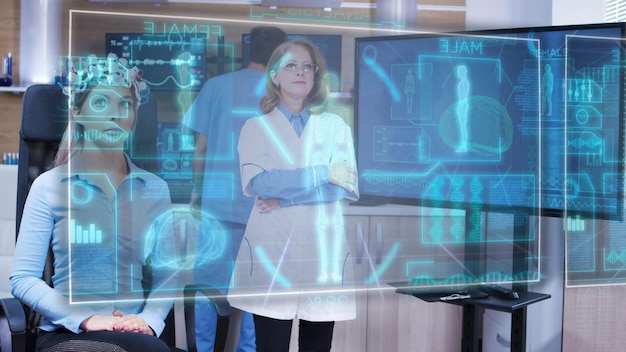
AI-based medical diagnostics – a revolution brought about by computers?
The other day I stumbled across an article that nearly knocked me off my chair. It was about an AI system that can apparently make diagnoses much more accurately – and even more cheaply – than our human doctors. Sounds almost too good to be true, doesn’t it? But that’s exactly how it is – AI-based medical diagnostics are on the rise, and not just in sci-fi films. I thought: ‘I’ve got to take a closer look at this!’
Machines that assist us in the field of medicine have long since ceased to be the stuff of science fiction. But this time, real progress is being made: advanced AI systems could even revolutionise entire hospitals in the future. For more user-friendly operation, faster results and perhaps even better treatment outcomes. This naturally raises an intriguing question: can computers really be so intelligent that they can make better diagnoses than experienced doctors? This falls within the field of AI-based medical diagnostics, which is becoming increasingly important. But before we get into the details, we first need to look at why the whole thing is so massive.
What exactly does AI-based medical diagnostics involve?
Well, that’s one of the ‘superpowers’ of modern medicine. It involves using artificial intelligence to detect diseases even earlier, more accurately and often more cost-effectively. The idea is simple: rather than relying solely on a doctor’s knowledge and experience, an AI-based medical diagnostics search through vast amounts of data, identify patterns and use them to derive so-called patterns or ‘fingerprints’ for specific diseases. This can sometimes even lead to a diagnosis being made before the symptoms become clearly apparent. It sounds almost too good to be true, but it is a reality.
How does that actually work?
In principle, the system is nothing more than an optimised pattern-recognition programme. It is fed with millions of clinical presentations, images, laboratory results and even genetic data. Through machine learning, it learns to recognise correlations that are often barely visible to the human eye. The result: an analysis that, in a matter of seconds, can be significantly more accurate than the human eye. This is particularly true for diagnoses based on imaging techniques such as MRIs or X-rays, where the AI-based medical diagnostics extremely promising. No wonder that more and more hospitals and doctors are turning to this technology.
What are the benefits? Why is AI such a popular tool?
- Speed: More and more tasks can be completed in a matter of seconds, rather than taking hours or days of analysis.
- Accuracy: AI systems are constantly learning and can detect minute variations that are barely visible to the human eye.
- Cost savings: When dealing with large volumes of data and routine diagnoses, you’ll eventually save money – this presents a real opportunity for healthcare systems.
- Risk-free work: AI does not make mistakes such as those caused by tiredness or concentration problems, which can be extremely important when making a diagnosis.
Of course, there are also critical voices: some fear the loss of human connection in the doctor-patient consultation, or the risk that machines might take control. Yet it is in the combination of human and machine that the great opportunity lies: the doctor remains the decision-maker, but AI is the reliable assistant that takes the strain off them and supports them.
What challenges are there when it comes to implementation?
Of course, it’s not all plain sailing. There are plenty of challenges to overcome. Take data quality, for example: for AI to work reliably, it needs large amounts of accurate and diverse information. Otherwise, errors or biases in the data could skew the diagnoses. Furthermore, the use of sensitive patient data raises data protection and security issues. Last but not least, the technology must be extensively tested before it can be used in everyday practice. It will therefore be fascinating to see how this field develops in the coming years.
What does this mean for the future of medicine?
Imagine that, in a few years’ time, no hospital will be able to manage without an AI-based diagnostic tool. Detecting diseases at an early stage, developing personalised treatments and improving medical care – it all sounds like a dream of the future. But the reality is that a great deal of research is still needed, as well as acceptance amongst doctors and, of course, a suitable legal framework. For us patients, this means, above all, hope. Because this technology could make healthcare significantly more effective and equitable for everyone.
Conclusion: Will AI revolutionise medicine?
Looking at current developments, it’s easy to get the impression that AI-based medical diagnostics represent a huge leap forward. They can minimise errors, analyse data very quickly and help to detect diseases even earlier. But of course, no machine can replace humans – rather, it’s a brilliant addition. The interplay between data, artificial intelligence and human intellect could bring about significant changes in medicine. For us, this means staying alert and being open to innovations that make our healthcare system more sustainable. And who knows? Perhaps soon the doctor will be sitting next to me whilst an AI checks my blood pressure – and we’ll laugh together about the future.


